
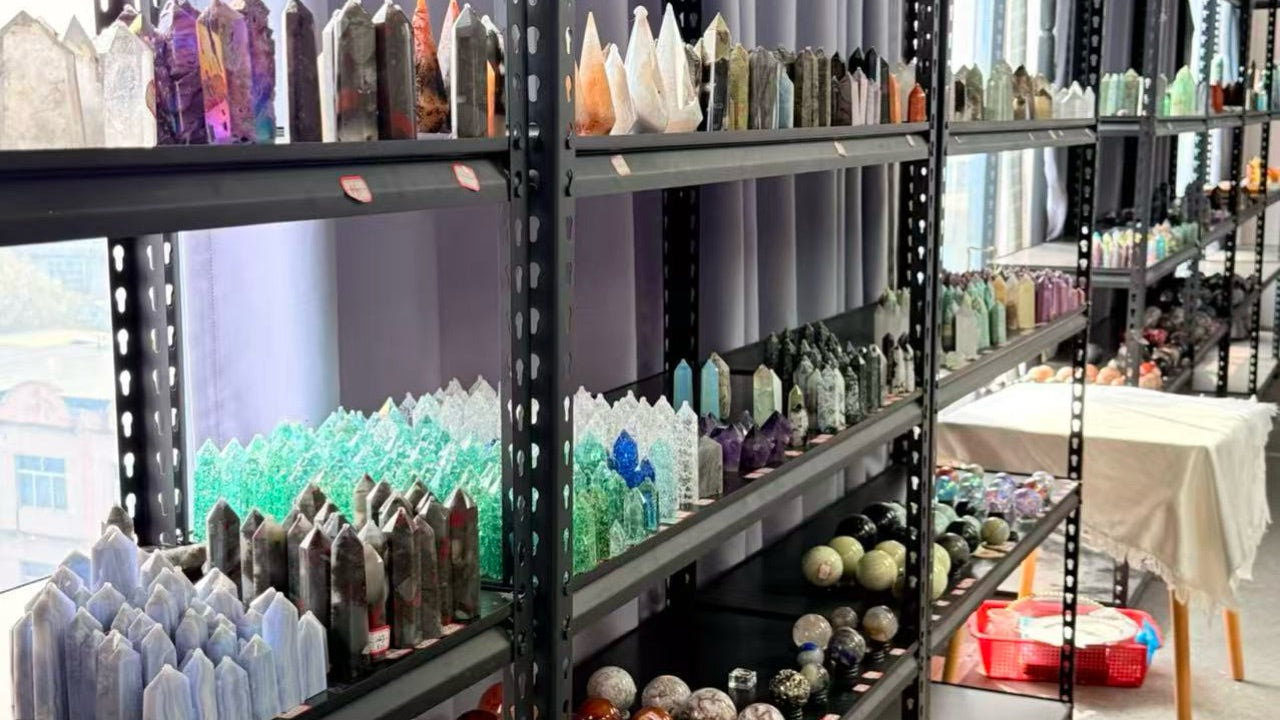
Wholesale Crystal Product Forms Explained: Towers, Spheres, Tumbled Stones, and More
Wholesale buyers often understand the material they want before they understand why a tower costs more than a tumbled stone of the same material, or how to decide which forms to carry at all. Product form — whether a material is cut into a…
Wholesale buyers often understand the material they want before they understand why a tower costs more than a tumbled stone of the same material, or how to decide which forms to carry at all. Product form — whether a material is cut into a tower, polished into a sphere, tumbled smooth, or left raw — affects far more than appearance. It affects how a piece displays, how a customer approaches buying it, what price range it tends to sit in, how it ships, and how it should be sourced. This guide walks through the main product forms in the wholesale crystal trade and how each one tends to behave across those dimensions, so an assortment can be built around function rather than visual variety alone.
1. Towers
Towers are cut and polished into a pointed column shape and often function as display anchors rather than high-volume sellers. Material use and production cost vary by material, finished size, cutting yield, grade, and processing, so towers do not sit at a fixed price position relative to other forms across all materials.
Display: Towers tend to work best with visible vertical space — a shelf with height clearance rather than a flat countertop bin. A smaller number of towers, well-lit and spaced apart, can do more for a display than a dense cluster.
Customer selection: Customers often choose a tower by picking it up and evaluating clarity, color, and proportions individually, which favors displays where towers are handleable rather than sealed away.
Price range: Price can scale with height, material, and finish, and the specific range should be confirmed per product rather than assumed.
Shipping considerations: Pointed forms can be more prone to chipping than rounded ones, but shipment risk still depends on material, size, packaging, and handling rather than the shape alone.
Sourcing decisions: Because towers are often chosen individually based on visual appeal, some size and material variety within the category can support a more functional display than depth in a single size.
2. Spheres
Spheres involve shaping a round form from a larger piece of material, and material use, cost, and finished price vary by material, size, grade, and cutting yield rather than following one fixed pattern across products.
Display: Spheres need a stand or a stable resting surface, which is a display requirement worth factoring into shelf planning.
Customer selection: Spheres are often chosen as an individual piece rather than as part of a larger multi-item purchase.
Price range: Pricing depends on size, material, and finish, and should be confirmed per product rather than assumed to sit at a fixed position relative to other forms.
Shipping considerations: Rounded forms can be prone to rolling and impact damage in transit, so secure, cushioned packaging is a relevant consideration for this category, alongside material and size.
Sourcing decisions: A smaller number of spheres across a range of sizes can serve this category's display role without requiring depth in a single size.

3. Tumbled Stones
Tumbled stones are smoothed through a mechanical tumbling process rather than individually cut, which can make them a more accessible option to stock in volume, depending on material and size.
Display: Tumbled stones tend to work well in bins, trays, or grid displays where customers can browse quantity easily.
Customer selection: Because individual pieces are often lower cost, customers may select tumbled stones without extensive individual evaluation, though this varies by customer and material.
Price range: This category is often positioned at a more accessible price tier relative to cut and polished forms, which is one reason many retailers use it to build material variety into a display.
Shipping considerations: Rounded, smaller forms can carry lower breakage risk than pointed or carved forms, but packaging, material, and handling still affect outcomes.
Sourcing decisions: Because tumbled stones are often a lower-friction purchase for customers, this category can be a practical place to source a wider range of material variety relative to budget.
4. Raw Crystals
Raw or rough crystals are left unpolished, close to their natural formation. This form tends to appeal to customers interested in a material's natural structure rather than a finished, symmetrical shape.
Display: Raw pieces can display well with minimal staging — a tray or open shelf that lets the natural form remain visible.
Customer selection: Selection tends to be individual and deliberate, since no two raw pieces look alike.
Price range: Pricing can vary meaningfully within this category, since size, formation quality, and material availability affect value without a standardized cutting process to normalize it.
Shipping considerations: Raw pieces can have sharp edges or fragile points depending on the material, which affects packaging needs and handling.
Sourcing decisions: Reviewing photos of the specific batch is often more useful here than ordering by material name alone, given natural variation.
5. Carvings
Carvings are shaped into specific forms — animals, symbolic shapes, decorative figures — involving detailed finishing work.
Display: Carvings can work well as individual featured items, since their appeal is often tied to the specific shape.
Customer selection: Customers may select carvings based on shape as much as material, which reflects a different buying motivation than material-focused forms like tumbled stones.
Price range: Price reflects both material and the complexity of the carving work, and can vary meaningfully even within the same material.
Shipping considerations: Fine detail work — small protruding features, thin sections — can increase breakage risk, so protective packaging is a relevant consideration for this category.
Sourcing decisions: A range of shapes in smaller quantities can support display variety more efficiently than depth in a single shape, depending on the store.
6. Freeforms
Freeforms are polished pieces that retain an irregular, natural-feeling outer shape rather than a standardized geometric form like a tower or sphere, making each piece visually distinct despite being finished.
Display: Freeforms can display well as individual pieces, similar to towers, though their irregular shapes mean spacing needs can vary more per piece.
Customer selection: Customers often select freeforms individually, based on the specific shape and finish of that piece, similar to raw crystals.
Price range: Pricing depends on material, size, and finish, and should be confirmed per product rather than assumed to sit at a fixed position between other forms.
Shipping considerations: Freeforms can be more durable than pointed towers in some cases, but individual wrapping is still a relevant consideration given their polished surfaces.
Sourcing decisions: As with raw crystals, reviewing specific batch photos can be more useful than ordering by material and size alone, given natural shape variation.
7. Palm Stones
Palm stones are shaped to fit comfortably in the hand — generally larger than tumbled stones but smaller and less detailed than most carvings.
Display: This form can work well in small trays or on countertops, occupying a middle ground between bin-style display and individual staging.
Customer selection: Palm stones are sometimes chosen for a tactile quality — customers may pick them up to feel the weight and smoothness, which is worth factoring into how they're displayed.
Price range: Pricing depends on material and finish, and should be confirmed per product rather than assumed relative to other categories.
Shipping considerations: Their smooth, rounded shape can support lower breakage risk, though this still depends on material and packaging.
Sourcing decisions: A moderate range of materials in this category can work well for stores that see it as a step-up purchase from tumbled stones, though this varies by customer base.
8. Crystal Bracelets
Bracelets are built from beads or chips strung together, appealing to customers looking for a wearable item rather than a display object.
Display: Bracelets typically display on stands, hooks, or in trays organized by material or color, and benefit from clear sizing information since customers are purchasing something meant to fit.
Customer selection: Selection often involves both material preference and sizing, which makes clear product information especially relevant for this category.
Price range: Pricing depends on bead size, material, and construction, and should be confirmed per product rather than assumed to match other accessible-price categories.
Shipping considerations: Bracelets can ship efficiently in bulk due to their compact, flexible form, though consistent quality control on stringing is a relevant factor for buyer satisfaction.
Sourcing decisions: Because bracelets appeal to a different buying motivation (wearability) than decorative forms, some retailers source them as a distinct line within a broader assortment.
9. Choosing Forms as a Set
Many functional wholesale orders combine several forms deliberately rather than treating each one as a separate decision. Tumbled stones and bracelets often carry a significant share of transactions in some stores, while towers, spheres, and carvings can serve a display's visual anchoring role. Raw crystals and freeforms tend to appeal to customers who value natural variation, and palm stones can bridge the gap between low-commitment and higher-commitment purchases. The right mix depends on your specific store, customer base, and space.
If you're deciding how those forms should work together in a new shop, the next step is to plan a balanced first wholesale crystal inventory.
FAQ
Which product form has the fastest turnover in a retail setting? This varies by store and customer base. Turnover depends on your specific display, pricing, and customer traffic rather than the form alone.
Should a new store carry all eight forms from the start? Not necessarily. Many buyers start with a smaller set of forms — often tumbled stones, a few towers or spheres, and bracelets if relevant — and expand as they learn more about their customers.
Why do prices vary between forms of the same material? Price differences can reflect the amount of raw material used, the labor involved in cutting or polishing, and material loss during shaping. These factors vary by material and should be confirmed with a supplier rather than assumed.
Are raw crystals harder to sell than polished forms? This depends on the customer base. Raw crystals may appeal to a specific segment interested in natural formations, while polished forms may have broader general appeal — neither is universally the case.
How do I decide how much shelf space to give each form? This connects to your overall display planning process rather than a fixed formula tied to product form alone.
Once you have selected the forms you need, you can prepare a sourcing request by material, form, and quantity before asking for a quote.
See Wholesale Services for ordering details.