
How Gift Stores Can Add Wholesale Crystal Products to Their Inventory
Retailers running gift stores often ask whether crystals fit their existing customer base at all, and if so, where to start. Gift stores tend to serve a customer who is often shopping for someone else, working within a specific price range…
Retailers running gift stores often ask whether crystals fit their existing customer base at all, and if so, where to start. Gift stores tend to serve a customer who is often shopping for someone else, working within a specific price range, and making a decision relatively quickly. That buying pattern differs from a dedicated crystal shop's customer, and it's worth letting it shape which crystal products make sense for a gift store's shelves.
This guide walks through how to choose products that fit your gift retail model, starting from the gift-buying customer rather than from a generic product list.
1. Start From the Gift-Buying Customer
A gift store customer is often shopping with a specific occasion or recipient in mind — a birthday, a hostess gift, a small thank-you item — and commonly works within a defined budget for that purchase. This differs from a customer walking into a metaphysical or crystal-specialty shop with an open-ended interest in the material itself.
This distinction matters for sourcing because it shifts the relevant question from "which crystals are popular" to "which crystal products fit how my customers already shop here." Products that are easy to understand at a glance, reasonably priced for a gift budget, and presentable without much explanation often fit gift-store purchasing patterns more naturally than products that require material knowledge to appreciate.
2. Product Categories Retailers Often Consider for Gift Stores
The following categories are worth considering for a gift store — not because they are inherently "gift store products," but because their price point, presentation, and purchase decision speed can align with how gift-store customers already shop. These products can be useful when merchandised to fit a gift context; how they're packaged or presented is a decision each retailer can make based on their own store. Before reviewing them individually, it helps to understand which crystal forms suit gift-focused displays.
Crystal Bracelets
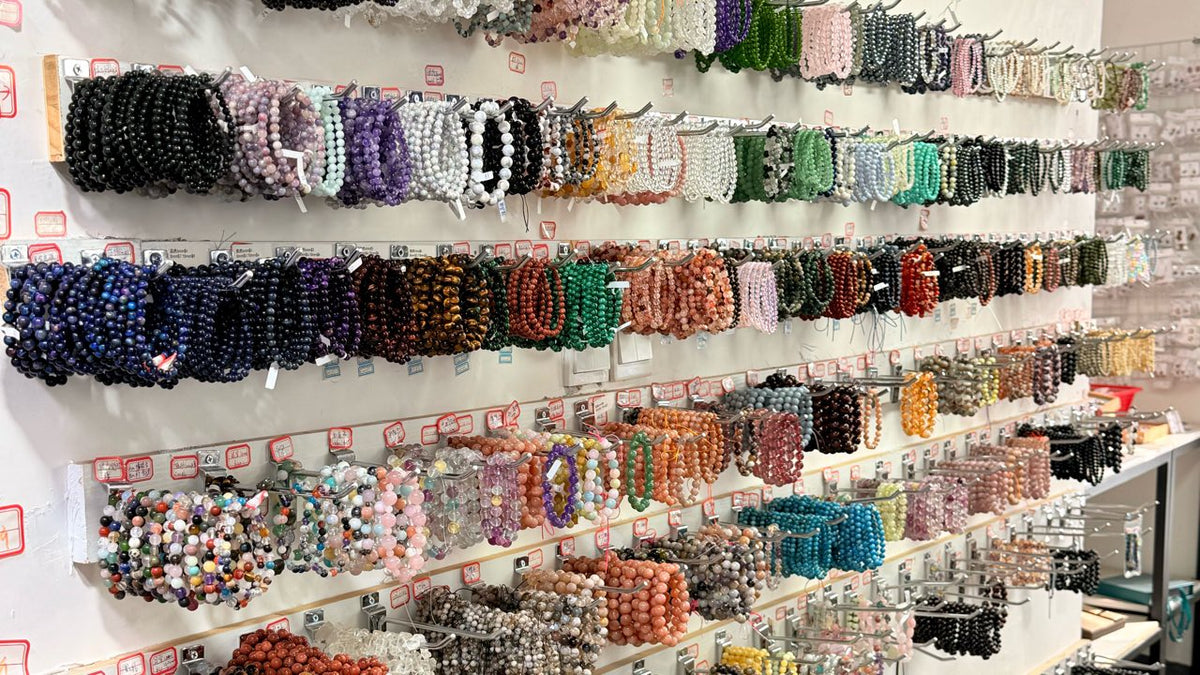
Bracelets can fit a gift-buying pattern well because they're a complete, wearable item that doesn't require the recipient to understand anything about the material to enjoy it. They also tend to sit in an accessible price range, which can fit a typical gift budget. For a gift store already selling jewelry or small accessories, bracelets may extend an existing merchandising category.
Small Carvings
Small decorative carvings — figures, symbolic shapes — can fit gift-store purchasing considerations because they function as a self-explanatory decorative object. A customer often doesn't need background knowledge to understand what they're buying, which can suit a quick gift-buying decision.
Tumbled Stones
Tumbled stones are often considered by gift retailers because their lower individual price point makes them approachable as a small add-on gift, without requiring a large purchase commitment. How they're packaged for a gift context — individually, in small bags, or as part of a set — is a merchandising decision each retailer can design around their own store and supplier options.
Decorative Pieces
Small decorative pieces — palm stones, small freeforms, or compact display items — can work as desk or shelf decor gifts, particularly when sized and priced similarly to other decorative items a gift store might already carry, such as small figurines or paperweights.

3. Presentation Is Worth Planning Alongside Product Selection
For a gift store, how a crystal product is presented can matter as much as the product itself. Gift customers often respond well to clear, simple presentation — a bracelet on a card with basic material information, tumbled stones grouped in a labeled tray, a carving displayed with enough space to be appreciated individually. Packaging and presentation formats are merchandising choices each retailer designs for their own store; they are not a standard service tied to any specific product.
This differs from a crystal-specialty shop, where customers may be comfortable browsing loose, unlabeled bins because they already have material knowledge. A gift-store customer often benefits from presentation that reduces the need for prior knowledge — simple labeling, clear pricing, and a display that doesn't require staff explanation.
4. Price Point Planning for a Gift Assortment
Gift purchases tend to cluster around a few common price thresholds — a lower tier for small add-on gifts, a middle tier for a primary gift item, and occasionally a higher tier for a more significant purchase. When adding crystal products to a gift store, it can help to map the assortment to price points that already work for existing gift inventory, rather than building a separate pricing logic for this category alone.
Bracelets and small carvings often work as middle-tier gift items in some stores, while tumbled stones and small decorative pieces can fill a lower-tier, easy-add-on role. This mapping isn't a fixed rule — it's a starting point to adjust based on your store's specific customer base and existing price structure.
5. How Much Shelf Space to Allocate
For a store adding crystal products as a new category rather than a primary focus, a modest, well-curated shelf or display area often works better than a large initial commitment. This allows a store to observe how the category performs alongside existing inventory before expanding it.
A practical starting point is to treat a crystal section the way you would introduce any new gift category — with enough presence to be noticed, but without displacing established sections of the store until there's sales experience to justify expansion.
6. Questions to Consider Before a First Gift-Store Order
- Which product forms best match the price points my gift customers already respond to?
- What presentation options could support quick, low-explanation purchases in my store?
- How much material and shape variety does a small initial order need to look intentional rather than sparse?
- What has worked in similarly sized display spaces for other product categories in my store?
Working through these questions, and discussing sourcing and product options directly with a supplier, tends to produce a more useful first order than guessing at an assortment in advance.
FAQ
Do gift store customers respond well to crystal products? This varies by store and customer base. Products with simple presentation, accessible pricing, and no need for prior material knowledge tend to fit typical gift-buying behavior more easily than highly specialized items.
Should a gift store carry the same range of products as a dedicated crystal shop? Not necessarily. A narrower, well-curated selection focused on categories that fit gift-buying patterns — bracelets, small carvings, tumbled stones, and decorative pieces — is often a more practical starting point than replicating a specialty shop's full range.
How should I price crystal products relative to my existing gift inventory? Mapping new crystal products to price tiers that already perform well in your store is generally more useful than building a separate pricing structure for this category alone.
Does packaging come included with tumbled stones or bracelets for gift stores? Packaging and presentation formats vary by supplier and by order, and should be confirmed directly. Many retailers design their own gift packaging to match their store's branding.
How much initial investment does a gift store typically need for this category? This depends on your store's size and budget. A modest, well-curated starting selection is often a practical first step, allowing you to observe performance before expanding.
Browse related categories: Crystal Bracelets, Carvings, Tumbled Stones, or see Wholesale Services for sourcing details.