
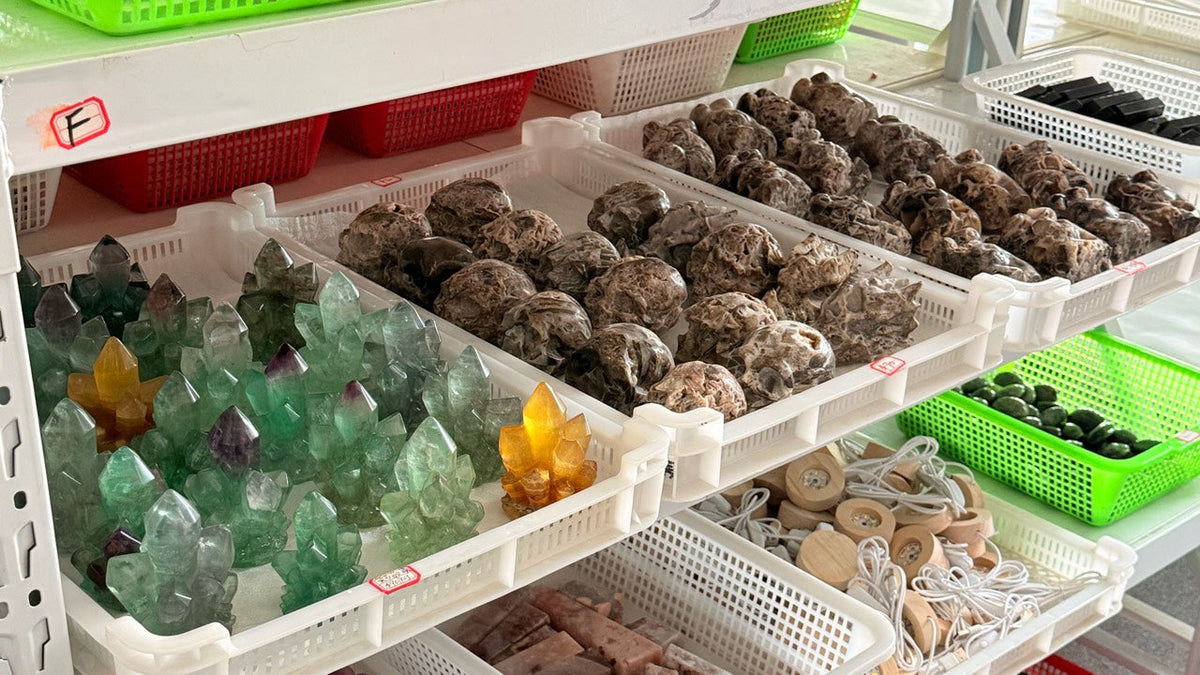
Wholesale Crystal Materials Guide: Understanding Different Crystal Categories Before Buying
Many buyers ask why the same material name can appear at very different prices across a supplier's catalog. The answer usually comes down to how crystal materials are grouped and described — by mineral type, by color, by formation, by trea…
Many buyers ask why the same material name can appear at very different prices across a supplier's catalog. The answer usually comes down to how crystal materials are grouped and described — by mineral type, by color, by formation, by treatment — and suppliers don't always specify which classification a given listing is using. Understanding these categories isn't about becoming a geologist. It's about knowing enough to ask useful questions and compare quotes with more clarity.
This guide breaks down the main ways crystal materials are categorized in the wholesale trade, so you can read a product list or a supplier's catalog with a clearer sense of what you're looking at.
1. Mineral Family as a Starting Point
One way to categorize crystal materials is by mineral family — the underlying geological classification. Quartz, for example, is a mineral family that includes Clear Quartz, Amethyst, Citrine, Rose Quartz, and Smoky Quartz. These materials share a base mineral structure but differ in color and trace mineral content.
Other common mineral families in the wholesale trade include:
- Calcite — a soft, often translucent mineral found in a range of colors
- Fluorite — often recognized by banded or layered coloration
- Agate — a form of chalcedony, often recognized by banded patterns
- Jasper — an opaque form of chalcedony, typically found in earthy tones and patterns
Mineral family can provide useful context — materials within the same family sometimes share general characteristics like hardness — but pricing still depends on material identity, color, treatment, size, grade, form, and availability. A price for one Quartz-family material doesn't necessarily indicate the price of another; each material and specific product should be quoted on its own terms.
2. Color Variation Within a Single Material
A single material name can cover a wide color range. Agate, for instance, occurs naturally in multiple colors, and dyed Agate can expand that range further. When a quote lists a material without specifying color or treatment, it's reasonable to ask the supplier directly whether the color is natural or treated, and whether pricing varies by color.
Color consistency can matter for retail display, particularly when ordering a quantity intended to look uniform on a shelf. Confirming color range with a supplier before finalizing an order is a normal part of the sourcing process.

3. Natural vs. Treated Materials
Some crystal materials sold in the wholesale market are treated — most commonly through dyeing, heat treatment, or polishing enhancements. Treatment is a standard and often disclosed part of the trade for many materials. What matters for a buyer is asking suppliers to clarify treatment status for a specific material, since practices and disclosure standards can vary by supplier.
If a color looks unusually saturated or uniform compared to how a material typically appears, it's reasonable to ask whether the piece is natural or treated. Treatment status for any specific order should be confirmed directly with the supplier rather than assumed.
4. Formation and Cut: How the Material Was Shaped
Separate from mineral type and color, materials are also categorized by how they were formed or cut:
- Tumbled — smoothed and polished through a tumbling process, producing rounded, handheld pieces
- Raw/Rough — left in or close to natural formation, unpolished
- Cut and polished forms — towers, spheres, pyramids, and similar shapes cut from larger material and finished
- Clusters and geodes — naturally formed groupings, typically left closer to their original structure
The same mineral material can appear across these formation categories, and formation generally affects price, since cutting and polishing involve labor and material loss that vary by piece and by material. The specific price relationship between formation types should be confirmed per material rather than assumed to follow a fixed pattern. Before comparing product listings, it helps to understand the difference between crystal materials and product forms.
5. Grade and Clarity Terminology
Suppliers sometimes use grading terms — such as "A grade" or "AA grade" — to describe clarity, color consistency, or overall visual quality within a material batch. Grading terminology is not standardized across the industry. What one supplier calls "A grade," another may describe differently, and there is no universal, third-party certification body governing these labels in the general wholesale crystal trade.
Because of this, grading terms are more useful as a relative description within a single supplier's catalog than as a basis for direct comparison across suppliers. Requesting photos or samples of the specific grade being quoted is generally a more reliable approach than relying on the label alone.
6. Questions Worth Asking When Comparing Quotes
When reviewing a quote listing material names, it can help to ask the supplier to clarify:
- Which mineral family the material belongs to, if not obvious from the name
- Whether the color is natural or treated
- What formation/cut category applies (tumbled, raw, polished, etc.)
- What the grading terminology means in that specific catalog
Terms, availability, treatment status, and grading definitions should be confirmed for the specific supplier and order rather than assumed from general industry patterns.
FAQ
Is a higher-graded material always the better choice for a retail display? Not necessarily. Grade affects clarity and visual consistency, but the right grade for a display depends on price point and customer expectations as much as on the grade label itself.
How do I know if a color is natural or treated? Ask the supplier directly for that specific material and order. Disclosure practices can vary, so it's worth confirming rather than assuming.
Why do prices vary within the same material name? Price differences within a single material name can reflect formation/cut category, size, grade, and availability, all of which vary even when the base mineral is the same.
Are grading terms like "A" or "AA" standardized across suppliers? No. Grading terminology varies by supplier and is not governed by a universal industry standard, so it's best treated as relative within one supplier's catalog.
Should I request samples before placing a larger order? For unfamiliar materials, or when color and grade consistency matter to your display, requesting samples or detailed photos before a larger order is a reasonable step to discuss with your supplier. Sample availability and terms should be confirmed directly, since practices vary.
Once you have clarified material, treatment, grade, and formation, you can prepare a clearer wholesale sourcing request for a supplier to quote.
Browse materials by category on Towers, Spheres, Tumbled Stones, and Raw Crystals, or see Wholesale Services for sourcing details.